
Archive for the ‘Uncategorized’ Category
Organizational Health-Part 3-Communicate Clarity Repetitiously

In part three of our series on organizational health we explore the need to communicate the clarity we defined in part two by communicating that clarity repetitiously. If the core messages relaying the priorities of an organization are not communicated repeatedly, the message will be quickly lost and forgotten. How many times have you attended a company town hall meeting given by the CEO where s/he reviews a presentation explaining the organization’s direction, priorities, timelines, roadmap, etc. and everyone leaves the meeting excited and charged to start making change; then six months later that message and call to action has all been forgotten? The flawed thinking here is the executive leadership team thinks they’ve completed their job by simply communicating the message once. The first communication of that message is simply step one of executive leadership’s job to communicate clarity. This article will explain the importance of why those messages need to be repeated to become engrained in the organization.
There are many reasons why top leaders fail to repeat key messages or priorities over and over again. Whether its because they don’t want to sound insulting or patronizing, or they believe repeating the same message is simply a waste of time, it fails to drive home the importance that communicating repetitiously institutes authenticity and creditability. If employees hear the same message repeatedly by leadership and by other employees and staff, they are more likely to embrace the message once they understand how it affects the organization and what their role is to help the organization successfully achieve the results of that message. The weight and priority of the message should dictate when and how often the message is delivered. The same message can be delivered through a variety of different methods or mechanisms. This could range from something simple like email reminders to something more extravagant like a full-blown marketing media blitz with videos that include actual employees. Another approach to communicating repetitiously is to use a technique called cascading communication. This strategy has senior leadership exit their meetings and communicate the directives down to their direct reports. The three secrets to cascading communication are: there needs to be message consistency from one leader to another, timeliness of delivery, and real-time communication. If possible, executive leadership should meet all their direct reports in person; that way when the message(s) are delivered it gives the opportunity to ask questions and get real-time clarification before repeating that message down the chain to next level reports. Executive leaders should always ask themselves the question “what is the unified message we are going to communicate back to our direct reports?” This ensures the message remains cohesive when using cascading communication. We live in a world today where employees have more access to information, websites, webinars, newsletters, announcements, etc. than ever before. So why do they feel more uninformed than ever? It’s not about the volume of data that gets relayed, but it’s the core messages that are conveyed regularly and consistently.
So how do we know when we have successfully communicated clarity repetitiously? First, it’s when executive leadership has clearly communicated the six questions of clarity to all employees and organizational staff. Second, when employees and staff consistently remind their colleagues in their departments about those answers of clarity. Third, when both leadership and teams leave meetings with specific agreements about what to communicate to their direct reports, and then they ensure those messages are cascaded down the chain quickly after meetings. Fourth, when all employees and staff can accurately articulate the organization’s reason for its existence, its values, objectives and goals. Let your executive leadership know this is what you expect from them and ask how you can help to do your part to make sure that repetitive communication is successful across the organization.
Organizational Health-Part 2- Communicate with Clarity

In part two of our series on organizational health, we will examine the importance of leadership teams communicating with clarity to their organizations. The importance of this cannot be overstated. In fact, until organizations can master this, those company mission and vision statements are simply words on a wall with little meaning.
Communicating with clarity requires leadership teams to go back to the basics. What I mean by this is returning to those simple but critical questions which define why and how your organization exists? Once leadership can agree to the answers to these questions, this will set the foundation for organizational alignment and health. To be completely effective, this set of questions is meant to be answered collectively.
- 1. Why do we exist?
- 2. How do we define values?
- 3. What do we do?
- 4. How will we succeed?
- 5. What is the single most important priority right now?
- 6. Who does what?
While these questions seem simple, even trivial, getting the answers is not. Getting these answers will require three things; one, total buy-in or cohesion from the top. To achieve communication alignment, it needs to start with the highest levels of the organization. Second, keep the language simple. Many times, getting caught up on fancy marketing phrases can easily result in ambiguity and lead people astray with the true meaning of the answers. Third, allow for an ample amount of time to come up with these answers. The key here is to first get something down on paper, and then take a few weeks to refine those answers until all members can at least agree they communicate the direction or path of the organization.
Question 1: Why do we exist?
Simply put, what is the organization’s main purpose? What is the main reason(s) why the organization exists? Every organization’s leadership team should be able to identify this and put it into clear and concise language. Even if leadership has already done this, now would be a perfect opportunity to revisit this question and affirm the answer(s) have not changed. The key here is to determine what the motivations of the owners or founders were when the organization was first started. Depending on the age of the company and availability of those that were around in the very beginning, it may be difficult to uncover those true passions and motivators. If that is the case, then the approach should be to have leaders try and answer these questions as if they were the founders. Getting to the true heart of this is like peeling an onion. If you come up with a general statement such as “we strive to provide superior service to our customers”. The next question should be “Why do we strive to provide superior service to our customers?” The answer to that question should also be followed with why. That process repeats with asking why until the most idealistic answer for why we exist is uncovered.
Question 2: How do we define values?
For any company to become organizationally healthy, it requires a close look at its values. Values are another way of saying company culture. This is how we do things here. Nothing is more important for an organization than to communicate with clarity what it stands for and what it values. This impacts many different groups of individuals that interact with the organization, such as employees, external partners or vendors, and customers. When an organization identifies and exercises its values, it must communicate them with clarity. One of the benefits of this are attracting the right employees while repelling the wrong ones, therefore, making recruiting easier and reducing employee turnover. When customers believe in and stand by a company’s values, it strengthens the organization’s brand and reinforces customer loyalty.
There are different kinds of values organizations identify with and maintain. These include core values, ambitious values, behavioral values, and unintended values. Core values are the ones that are deeply engrained into the fabric of the organization. They are the guideposts for how organizations make their decisions and how they run their operations, and do not change over time. Core values are what organizations stand by even when they are in the middle of adversity or on the wrong side of public opinion. They would even be willing to depart with employees, vendors, and customers, if that is what is required to defend their core values.
Ambitious values are ones the organization would desire to have and believes it must develop to maximize its success. Unlike core values, ambitious values are manufactured into the culture and could change over time. Therefore, it is a common mistake for organizations to confuse the two. Leaders need to understand the difference between each.
Behavioral values are ones that can easily be confused as core values. Examples of this are: integrity, respect for others, honesty, etc. While these are certainly nice to have as core values this would mean the organization would need to hold themselves in a very high regard, higher than most other organizations in existence. Keep in mind that core values are ones that are non-negotiable for an organization. This means that no matter what the circumstance, they will not tolerate any deviation from them. In business, there could be a blurry line between what some would consider ethical and unethical business practices. If one of your organization’s core values is integrity, look closely at your organization’s business practices because they may not fully fall in line with your organization’s core values, but more likely behavioral values. The point here is to make sure you place all your organization’s values in the proper categories. Unintended values are those that have developed within the organization over time but were not purposely established or agreed upon by leadership. They are the unplanned result of the organization’s business practices over time. For example, Google’s hiring practices early on were focused on hiring the best and the brightest. What that meant for Google was hiring people with advanced technical degrees, certifications, and a high-grade point average. The unintended result of this was many of their hires had the technical skills needed for the job but did not have the soft skills required to work with teams. This resulted in a high turnover rate for them.
Question 3. What do we do?
This question is the easiest of all to answer. There is no need to come up with a clever or abstract phrase here, just plain English with a couple of sentences that explain what the company does. Think carefully about the nouns and verbs that describe the business.
Question 4. How will we succeed?
All organizations come with different ideas and definitions about their strategy. In the most general terms, strategy can be defined as an organization’s collection of deliberate decisions to give itself the best position to prosper and segregate it from its competition. So, how does this translate into actions that an organization’s leaders can follow? The key is to identify and write down everything that can be identified about the organization. This includes anything from how the company markets its products, to how they view and treat their employees. The output is a big list of things that may appear unrelated, but, in fact, are related. Examples of items in this list would be: product pricing, marketing, service, end-user experience, supply-chain, hiring, employee benefits, training, employee development, promotions, diversity programs, social responsibility, etc. Once you have a list that seems comprehensive, then look for three common traits or features that may tie two or more items together. Write down those common traits. These traits are ones that are fundamental to the organization in how they make their most important decisions. Through this process new traits or features may appear. Be sure to capture those as well. These traits act as filters which provide clarity to leadership for what they should be focused on and what they shouldn’t be focused on.
Question 5. What is single most important priority right now?
As the old saying goes, if everything is a priority then nothing is a priority. One of the most common traps many organizations fall into and follow today is establishing multiple priorities with the expectation that everything is completed on time, within budget, and with superior quality. The reality is what gets produced is late, over budget, and with sub-standard value. This is because organizations think that doing more equals getting more. While that may be true, the question becomes, at what cost? If the organization wants to create a sense of alignment, it must identify a single, top priority to be achieved within a certain time.
In one of my past blog posts, I wrote about project managers having a sense of urgency. Organizations should carry that same sense of urgency around the most important priority identified by executive leadership. Leadership should identify a single, urgent priority that must be met, completed, or satisfied by the organization within a certain period. This single priority will provide the clarity not only to leadership, but also to the rest of the organization in how and where it spends it’s time, energy, and resources across the organization. Once this is agreed upon, every executive member must make this a priority within their business division or department. This idea ties back to my first article in this series: Organizational Health Part 1: Strong Leadership Teams.
After the priority has been established, the next step is to define four to five defining objectives which support meeting the most important priority. These are the general categories of activities that arerequired to meet the priority. These can be defined as temporary, agreed upon by leadership, and qualitative in nature. The last area covered is identifying the standard operations objectives. These objectives are the day-to-day areas that leadership is required to keep fixated on while focusing on the priority goal. These include things like revenue, marketing, new business, customer retention, etc.
Question 6. Who does what?
While this question seems straightforward, there are traps that leadership can easily fall into when compiling these answers. It is easy to assume that clarity exists, and everyone knows exactly what they are responsible for and what is someone else’s responsibility. Don’t let job titles or job descriptions support those assumptions or confuse the role. To test this out, try this simple exercise; have each one of the executive leadership team members write down their role and responsibility, as they understand it within the organization. Compare each member’s notes to see if they captured their role and responsibility correctly, if there was any overlap (two or more members wrote down the same responsibility), and finally, if there were any missing responsibilities due to one or more member’s assumption that the role or responsibility was being covered by another member.
Summary
After the leadership team has agreed on the answers to all six questions, the next step is to write them down in a document that can be used for future decision making, planning and communications. Some organizations call it a playbook, some call it a bible; it really doesn’t matter if it is used and not sitting on a shelf somewhere. When drafting this document be sure to keep it short. Making it lengthy and including unnecessary information will only discourage people from reading it and discount its meaning and effectiveness. Finally, each member should keep a copy of the bible with them always when attending off-site meetings, staff meetings, and other gatherings to remind themselves and communicate to employees what the bigger picture is behind the organization. By consistently using these answers to guide the organization in their decision-making, planning, and communications, it will keep the leadership team communicating with consistency and clarity.
Organizational Health – Part 1 – Strong Leadership Teams
When was the last time your company received an organizational health checkup?
No need to? better think again…. chances are, it could be suffering from the “organizational flu” and your leadership team doesn’t even know it. If you ask your leaders what the issues are what will they tell you? Poor communication? Poor decision making? Trying to do too much too fast or with too little? What is it about poor organizational health and leadership that results in companies missing the problem altogether? Even more importantly, what is it really costing your organization in terms of lost revenue, time, and resources? Perhaps the answers are hiding in plain sight and appear to be so common sensical and trivial that they are not given the credibility they deserve. The fact is poor organizational health and leadership exists within thousands of organizations across the globe, but only a fraction of them have taken notice and are actively doing something about it.
In this first of a four-part series on the need for good organizational health, we will look at the importance of constructing a solid leadership team. In the next article we will concentrate on how leadership teams communicate with clarity, the third article will focus on a leadership team’s approach to clarity on organizational alignment, and finally, we will conclude with how leadership teams strengthen that clarity and alignment.
Good organizational health starts with building a solid leadership team. We have all heard this one before, but what does building a solid team really mean? Let’s first define “team”. Team refers to a group of individuals who have a shared responsibility for achieving mutual goals for their organization. This is not to be confused with work group, which can be defined by Webster’s as: “a group of people who work together: such as an organized group of coworkers within a business or other organization”. The big difference here is a team works together collectively, putting the organization’s needs above individual member or department needs. Now that we are clear on the definition of a team, let’s look a little deeper into the makeup of a team. For a team to be truly effective, it should consist of no more than 10 members. Studies have shown when teams consist of more members, not only is there an increase in the number of lines of communication, but the dynamics of communication change. The communication goals of members tend to shift from having an open and information-seeking type communication (inquisitive) to one of getting one’s point of view across and seeking as many supporters as possible to support their opinion. (sponsorship). Teams having more of inquisitive communication style exhibit six common traits.
- Teams not too large (less than 10 members)
- Team members deeply trusting each other
- Engaging in healthy conflict among each other
- Attaining commitment from each other
- Obtaining accountability from each other
- Concentrating on results
Trusting each other sounds very trivial, but here is what it really means; reaching a point where team members stop second-guessing decisions they have made, leaving their pride and ego by the wayside, and allowing themselves to become vulnerable to their team members. For you and your team to exhibit this type of behavior means you have reached a comfort level where open and honest conversations can take place with one another without feeling like you are overthinking words or actions, and politics are not a means or a motive in achieving goals and objectives for the organization. Teams functioning in this manner may seem truly utopian, but it is possible with a lot of work.
Once team members establish a deep trust with each other, then it can open the door for members to feel comfortable enough to have open and deep discussions that may involve conflict. This isn’t possible without establishing a deep trust first. Achieving this trait can be very challenging because you first must work through the organizational culture, where any kind of conflict may be frowned upon. Second, once you have mastered the organizational culture, you then must account for other types of culture, such as a team member’s country culture. Those working for multi-national firms know this better than anyone. What may be acceptable within U.S. culture may not be acceptable within a culture outside of the U.S. This is another reason why trust is a predecessor to this trait. It is necessary for all team members to trust one another and express themselves when they are not feeling comfortable with the actions of the team. Guidelines and rules of engagement are always helpful when team members feel like they are entering an unknown or uncomfortable area. If conflict is avoided at the top levels of the organization, rest assured, it doesn’t disappear from the organization, it is simply transferred to other parts of the organization where a much larger number of employees will feel its discomfort. Healthy conflict among executive leadership is necessary, and in some extreme cases, can protect an organization’s mission, vision, and core values if the company starts to drift away from why it was established in the first place.
This trait will require team members to master healthy conflict before mastering commitment from team members. One of the requirements of getting commitment from a team member is ensuring they have had an opportunity to express their opinion, ask questions, and understand the rationale behind project, goal, or organizational objective. Sometimes, going through these actions requires healthy conflict. If we look at the other side of the coin, we see people passively agreeing to something they didn’t necessarily support or believe in. Don’t expect these folks to come forward to be your change champions; in fact, they are probably going to be the ones that sit in their cubes, patiently waiting for decisions to blow up or go south and then say, “well, I never fully agreed with that decision anyway”. When teams meet to discuss goals, objectives and assign responsibilities, it’s extremely important to ensure each member has accepted total buy-in and commitment to the end-goal.
The fourth trait of a solid team is holding team members accountable. If the team is expected to accomplish its goals and mission, its members must be accountable for their decisions and actions. If team members don’t have complete buy-in or commitment (trait 3), it’s going to be very difficult to hold them accountable for only passively committing. Therefore, it is essential for all team members to be given an opportunity to voice their opinions, concerns, and ideas on projects and other organizational initiatives. Once this process has taken place and a final decision has been made, it is up to the team member to either fully support the decision or resign themselves from the team. Teams function best when there is peer-to-peer accountability.
Lastly, solid teams never lose sight of focusing on the results. It will be difficult to achieve results if the first four traits are not found within a team. If individuals are members of a higher-level team, they must keep in mind that organizational goals should always take priority over individual or department goals.
Now that we have reviewed the six traits of a solid team, take a step back and look at the teams you are a member of; do they exhibit these six traits? If you are unsure, following the checklist below:
- The team is not too large (three to 10 members)
- Team members trust each other and can become vulnerable with each other
- Team members can engage in healthy conflict
- Team members conclude meetings with specific agreements and commit to decisions
- Team members don’t hesitate to hold each other accountable for commitments and behaviors
- Members of the team put their collective priorities and needs of the larger organization above their own and their department’s priorities
The Single Project Management Skill That Trumps All Others
Being an IT project manager today is more challenging than ever. After satisfying the basic requirements of having a currently active Project Management Professional (PMP) certification and at least five years’ experience with managing IT projects in areas such as infrastructure or application development, project managers are also expected to have technical experience in at least one of those areas. For those project managers that started their careers 20 years ago without certification, they may find meeting these requirements difficult. The Project Management Institute (PMI) recently changed how practitioners need to earn their Professional Development Units (PDUs) to maintain their certifications. Industries hiring project managers voiced their dissatisfaction with PMP certification holders, stating they were coming up short in several areas which needed to be addressed. Today, to earn PDUs toward maintaining certification a project manager can earn them under five different areas: Technical, Leadership, Strategic & Business, General Education, and Giving Back. Next-Gen project managers will need to be more well-rounded in these areas in order to not only achieve and maintain certification, but also to be successful in today’s workplace.
With all of these new skills, along with a certification, soft skills are also now in demand. If you asked 1,000 project managers what is the one soft skill that sets an excellent project manager apart from the rest you would receive 1,000 different answers. My answer to this question is creating a sense of urgency, and here is why. If you look at the typical answers most project managers give, they are things like communication, leadership/team building, stakeholder management, and negotiations/conflict management. Don’t get me wrong, these are all crucial skills needed in project management, but what makes creating a sense of urgency unique is that it is essential with all of these other skills. At some point, all of these skills will require a sense of urgency. Being a great communicator is essential, but what exactly does that mean? To me, it means understanding when it’s essential to execute a sense of urgency and not creating a false sense of urgency. Creating a false sense of urgency can be just as detrimental as not creating a sense of urgency at all, and learning this skill only comes from experience.
Let’s use communicating change in the form of a new enterprise-wide project to across the organization as an example. As a project manager one of the first steps in communicating change is creating a sense of urgency, and this requires gaining the cooperation and trust of management and employees. Creating a sense of urgency sends a signal to the organization that a change must occur. One of the best ways to accomplish this is by having senior leadership market the value of the future state while communicating that remaining at the status quo is not an option and could be dangerous for the organization. Senior leadership’s responsibility is to instill that sense of urgency within the executive team. The executive team’s responsibility is to introduce it to its management and employees, creating a trickle-down effect. Once the sense of urgency has been created in the top levels of management, it is the project manager’s job to assist in driving and executing that urgency on the project.
So what are some examples of how a project manager would accomplish this? It depends on the project. Let’s use the example of an organization moving off of one email platform and over to another. This type of project touches every user, every desktop, and every user’s mobile device in the organization. It’s highly visible and has the risk of being highly disruptive across the company if not executed correctly. With this type of change being introduced to the organization, it is essential for senior leadership to communicate the need to move off of the old email platform, over to the new system, AND communicate how it puts the company at a disadvantage or risk if this change is NOT made. Once the decision and direction have been established, senior leadership communicates the mandate. Having project ambassadors delivering this message is a great way to accomplish this across the lower levels of the organization. Their role would be to:
- 1. Help employees understand the change taking place and why
- 2. Help employees educate themselves and directing them to all available information sources for the project
- 3. Provide project updates to department staff at staff meetings
- 4. Be a positive advocate for change
- 5. Assist the project team with local change management tasks
When it comes to leadership and team building, knowing when to apply a sense of urgency is critical. For example, if one of your project team members is not performing up to standards and is leaving some of his responsibilities for other team members to complete, stepping in quickly to address this issue is critical. If the matter is left to linger, or for the rest of the team to figure out or work around it, team morale can plummet and the work environment can become toxic. For a project manager, creating that sense of urgency is stepping in immediately to address the problem and communicate the solution. The sense of urgency message, in this case, is team cohesion.
For a project manager, understanding who their project stakeholders are, what their requirements are, who are the most important, the most vocal, and most dangerous to a project is critical to a project manager’s success. Every project manager must have a Stakeholder Management Plan to address this. Once a project manager understands who’s who by conducting a stakeholder analysis, then they can determine when and with whom creating a sense of urgency is necessary. One output to the Stakeholder Management Plan is the Stakeholder Map, which plots every stakeholder on a four quadrant map based upon individual levels of interest and influence on a project. Don’t be fooled by titles. Just because a stakeholder carries a certain title within the organization, it does not automatically equate power or influence. Let me give an example. A few years ago I was working with a client who had a large international presence on several continents. The organizational structure was diversified. Individual countries were managed by a country CEO. Regional Managers were in place to handle regional duties. A global CIO for the organization was hired and began to report to the CEO of the organization. Next, the Regional Managers began reporting to the CIO. The new CIO kicked off a portfolio of new infrastructure projects, hired a Program Manager and several project managers. There was one group of key stakeholders who were left out of these projects, Country CEOs. At the direction of the global CIO, who was also the executive sponsor of these projects, this was done intentionally. The end result was these projects ran into resistance, were delayed, and eventually paused indefinitely because a key group was left out. The CIO left the organization shortly after. The moral to this story is just because you carry a global title over other stakeholders, even if you are the executive sponsor, does not mean you carry more influence. Understanding where the political minefields are within stakeholder management is essential for any executive sponsor or project manager to learn as quickly as possible. In this example, the sense of urgency action was to engage the missing stakeholders on the project ASAP. How do you do this when your executive sponsor is deliberately excluding them? The answer to this question brings us to our last topic, negotiations and conflict management.
In this particular instance, a project manager would have two options. Option A would be to schedule a meeting with the executive sponsor and try to negotiate getting these stakeholders included/engaged on the project. If there are backroom politics at play here this may not be possible. At a minimum the project manager should at least communicate, with a sense of urgency to the executive sponsor, the risks to the project if those stakeholders are not included. Option B would be to contact the executive sponsor’s supervisor. If Option A was already attempted and it failed the project manager may consider Option B, but this is a risky move and it should be weighed very carefully.
As a consultant and project manager who has worked with dozens of organizations on a multitude of projects, the one thing that has always helped me be successful is bringing a sense of urgency to these projects. Bringing that sense of urgency means the client and project manager are working at the same tempo, and that paves the way to work on and arrive at solutions much faster. Using all of the skills mentioned above, along with knowing when creating that sense of urgency is necessary, will help any project manager deliver a successful project for any client for which they work.
What is Your Energetic Makeup and Why is it Important as a Leader?

Everyone has an energetic makeup. What’s yours and how does it affect your thoughts, feelings, and decisions as a leader? Your energetic makeup is comprised of two types of energy: catabolic and anabolic. Catabolic energy is draining, resisting, and contracting energy. It releases catabolic chemicals like cortisol and adrenaline into our bodies, which eat away at our cells. Catabolic energy can give you an energetic boost during a moment of stress, however, it can also act as a filter or blinder by showing you a limited view of a situation. This restricted view limits your choices available to you. When experiencing catabolic energy on a long-term basis, it takes an emotional, physical, and mental toll that is destructive on you, your organization, and all those around you.
Anabolic energy, on the other hand, is constructive, expanding, healing, and growth-oriented. Anabolic energy releases anabolic hormones such as testosterone into our body, and helps move us forward to achieve positive, long-term, sustainable results in all that we do. It is also useful in leading others in the same direction. Your use of anabolic energy allows us to have a more complete and conscious view of what is going on around us, and this allows us to come up with solutions and innovations more easily. Each energy type is exhibited by a chain reaction within our bodies. See the Energy Flow Chart below for how that chain reaction takes place. The creation of either anabolic or catabolic energy begins with our thoughts, and these thoughts provoke brain stimulation.


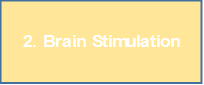
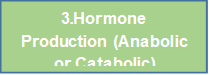



Figure 1: Energy Flow Chart
The brain then stimulates hormone production. It’s here where our core energy assumes an identity of either anabolic or catabolic. If the energy around the stimulation is catabolic it can generate feelings of sadness, apathy, conflict, or anger. If it’s anabolic it can create feelings such as forgiveness, compassion, and peace. Either way, these feelings will generate emotions which will lead to some type of action.
Both anabolic and catabolic energy are spread across a spectrum of seven levels known as the Energetic Self Perception chart. See the chart below. Read this chart from left to right, beginning with Core Thought on the left, Core Feeling/Emotion in the middle, and Action/Result on the right. Each one of us has something called an Average Resonating Level or ARL that falls somewhere between one and seven. This is the overall energy level we not only experience from life on a normal basis, but also when we experience stress. It is comprised of both the subtotal of every thought we have ever had, every emotion we have ever felt, every action we have ever taken, as well as those we are thinking, feeling and doing at the present moment. At any given time, our level of energy is some combination of these seven levels. Everyone has a mix of both energy types. Different energy levels show up in different situations for each of us. It is normal for all of us to move up and down this chart all day, every day, however, depending on life’s influences, some leaders may have more catabolic than anabolic energy.
Catabolic energy is found in Levels 1 and 2 (the deep blue section) and can be exhibited by feelings of apathy and anger respectively. The core thought around Level 1 energy is that of a victim- usually to events, thoughts, beliefs, and emotions. It represents of the things that hold us back from success. Core feelings with Level 1 energy are that of apathy or indifference, and the result of these feelings is the inability to take any action or to see any options. Those experiencing chronic Level 1 energy may carry feelings of self-doubt, guilt, and have very low self-esteem. Additionally, they may also experience worry and fear. All of this comes from victim energy. Those experiencing Long term, chronic Level 1 energy have just given up. They have adopted an apathetic attitude and see themselves at the mercy of life. The philosophy associated with Level 1 energy is “I lose.” An example of this could be an executive who will stall or avoid making decisions. This person is someone who does not want to take any initiative and who prefers to hang out in the shadows as opposed to sticking their neck out and being visible. They retreat from responsibility instead of stepping up to it. It is about avoiding that responsibility and decision making. They would rather just wait until either someone else makes the decision or until the decision is made by some other related action. The key characteristics are lack of motivation, not taking initiative, avoidance, and the thought behind these feelings/behaviors is whatever the outcome, it is going to be “I lose.”
With Level 2 energy (about 70% catabolic) the core thought at this level is conflict, which can translate to judgement, struggle, or black and white thinking. The core emotion tied to this level is one of anger. Those experiencing Level 2 energy can also have Level 1 energy along with it. These thoughts and feelings usually result in actions of defiance, resistance, or rebellion. Level 2 energy is the most prominent energy level in the world! Successful people with a lot of Level 2 energy have adapted to their life situations and know how to get what they want and don’t really know any other way to survive. They have been taught and have mastered the “winning at any and all costs” philosophy. Those who are successful in life who resonate at this level have learned to play the game and win. Although people may be successful, they are usually unhappy, ALWAYS unhealthy, and their success is limited. Continuing with the example of the executive making decisions, a Level 2 executive is someone who is forcing their agenda. Traits of this individual would be someone who is tasked with making a decision but does not take in information from those around them. They only care about the decisions they are going to make because they are the ones who have the power to make that decision. The way they read it, feel it, and see it- that’s the way they are going to do it. They make decisions on their terms only and this is solely based upon the fact that they are right and everyone else is wrong. This is not only about who has the decision making authority, but it’s also about who is right. This is where conflict, anger, and resentment could begin to develop among colleagues and employees. The thought behind this is they think they are the only ones with the experience and qualifications to make the decision. They are the only one who has all of the information to make that decision because other people don’t see what they see, and therefore, they are the best person equipped to make that decision. Executives with Level 2 energy hoard information instead of sharing it. It is a power struggle, and the belief is I have information that you don’t so I am more powerful.
Beginning with Level 3 (the light shade of blue) we start to see anabolic energy (about 60%). At this level, our core thoughts include responsibility and accountability; responsibility for how you feel and about anything and anyone. No one controls your realities or emotions. But let’s be clear; it is not about taking responsibility for other people’s actions, nor is it taking responsibility for actions in the past when you could not have known otherwise. It IS about taking responsibility from this point forward in how you interpret anything in your life. Level 3 is also about forgiveness. You forgive those who may have harmed you or held you back. Core feelings and emotions at Level 3 include forgiveness while letting go of any resentment or anger. Cooperation also begins at this level. Those experiencing Level 3 energy begin to cooperate with other people and begin to accept them for who they are whether they like them or not. The core action or results that come from this are usually cooperation, or working toward a shared goal or common benefit. The philosophy with Level 3 energy is “I win and hopefully, you win too.” Following with the example of the executive making a decision, the executive can be more cooperative when there are more people involved. This could be where the executive wins first then everyone else wins afterwards, or, it could be the company’s decision making policy comes first before the employees, customers, vendors, etc. The behavior here is about cooperation, but it’s also about how the decision that is made is going to put one entity’s priorities or interests first and above all others. It’s not about others losing or forcing something, but rather making the best decision for one specific party or interest.
At Level 4 (still in light blue) we have about 70% anabolic energy. The philosophy with this level of energy is “You win.” The core thought at this level is concern, interest and care for others. Those experiencing Level 4 energy are successful people who are able to get a lot done in less time. The core feeling or emotion here is compassion, sympathy, and concern for the suffering or misfortune of others. These feelings can be described as empathy, warmth, tenderness, and kindness. The results of these feelings are serving and helping others. Individuals with this level of energy are known as “The Helpers.” Continuing with our executive example, the behavior at Level 4 is all about concern for the other party. The decision is made solely with the other person/entity in mind. An example would be an executive who put their employees needs and interests first and made sure they are completely taken care of with hopes the company’s needs were also met in the process too. Many times this type of decision making requires executives to go out on a limb.
Level 5 is ideally the level where the philosophy is “We all win or no one wins.” Very successful people operate at this level of energy. They are able to create opportunities everywhere. It is at this level where we reconcile right and wrong and good and bad instead of looking at things in judgement. The core thought at this level is reconciliation, where we come together in agreement and understanding. Any judgement we may have disappears at this level. The core feeling or emotion at this level is one of peace, calmness, harmony, and contentment. The actions that result from these feelings are acceptance, a willingness to receive, and the acceptance of differences. Here is what Level 5 executive decision making looks like. The decision maker here does a couple things:
1. They share a lot of information and data with their team
2. They share the project and decision making with their team
You would see characteristics here such as trust, honesty, and forthrightness. They are seeking the decision that best meets everyone’s interests, so everyone wins. The other benefit to this approach is that the most obvious answers don’t always benefit everyone involved, and it requires sharing information and brainstorming to come up with the best answer. By taking this approach it moves the organization to a whole new level.
The last two levels exist in the outer part (purple) of the circle. At Level 6 there is almost pure anabolic energy. The core thought here is synthesis or a connection with you and everyone around you. Carl Jung described it as the “Collective Unconscious.”. The core feeling or emotion at this level is joy. There is a permanent sense of pleasure with life overall which can’t be taken from you. The action or result at this level is wisdom, or having insight, intuition, or enlightenment. This is the level where those tap into their “higher coach” and the philosophy of people at this level is “We always win.” One drawback with this level is that some may be perceived as being disconnected from reality. Our executive at Level 6 assimilates and shares information and data. They are open to trusting the instinct of others with whom they are sharing the information with by recognizing that the best decision will come from following that intuition and following the process to get you to that decision. Here, the philosophy is “We always win.”
Lastly, at Level 7, the core thought is one of non-judgement and lack of fear. This is the level of truth and true genius. Think of the color white. While it appears white has not color in it, it’s actually is made up of all the colors. When we operate in this level we are consciously aware of all other levels and can use them at will, without fear, and without judgement. The core feeling associated with this level is absolute passion or total bliss for any and all experiences. The action at this level is creation or genius thinking. Those operating with a Level 7 energy level believe “Winning and losing are illusions.” Some of the most successful executives in the world operate at this level. Executives that operate in this mode operate with a total lack of fear and while exercising non-judgment. They have an absolute passion for what they do and nobody is going to stop them from pursuing it. Executives at this level have the ability to create new experiences at will and can use all of the lower levels of energy as they choose because at this level winning and losing are just illusions.
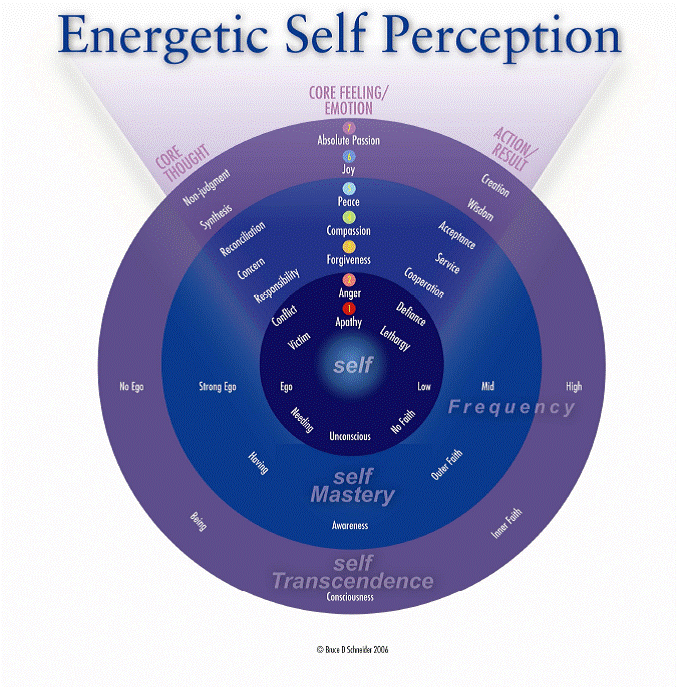
Figure 2: Energy Self Perception Chart
Source: Bruce D. Schneider: Institute for Professional Excellence in Coaching
How we display this energy and how we experience life is influenced by our thoughts, feelings, beliefs, and behaviors. Given the above information think about where you may show up on this scale with yourself, your friends, family, and colleagues. As a leader, is it where you want to be? Unlike our DNA, our energetic makeup can be changed if it is not serving us in the capacity we want.
If you are interested in discovering your true energetic makeup, contact us to schedule your Energy Leadership Index Assessment today. Its purpose is to help you with the following:
- Have a much sharper awareness of who you are and how you act
- Be able to respond instead of react to the stressors in your life in the way you want
- Understand what drives your perceptions, feelings, and actions so you can recognize and change habits and patterns that are not serving you well
This comprehensive assessment only takes 20 minutes to complete online, and will reveal more about who you are as a leader than you ever thought you knew.
Contact us today to schedule your Energy Leadership Index Assessment!
The Six Principles of DevOps and Why They Are So Important
DevOps is the end to end collaboration, performance measurement, and process automation flow. It enhances the software development lifecycle between development and operations teams; getting from business idea to measureable customer action with speed and agility in minutes and not months. It allows the team to be agile but at the same time mitigating risk. How can this be done? This concept is based upon six principles.
Principle #1: Culture
This,  by far, is the most important principle of the six, and it sits at the top of the list for a reason. Each organization has a different culture regarding how Dev. and Ops. are viewed within the organization. With many organizations, these two teams appear to be opposing forces. In DevOps, it is critical they work together, or as one. Their goal is to deliver successful results for the business for whom they work. This means coming together to develop a single methodology using people, process and technology. They must work together in harmony and foster an understanding of the challenges faced by each team. Adopting a holistic approach to delivery of the end-product or service is key. Removing the silos and building trust between the teams is essential in order for DevOps to be successful in your organization. The takeaway here is that everyone is working for the betterment of the company. Experimentation and change is NOT a bad thing.
Principle #2: Agile
Agile is the alternative to traditional project management (Waterfall), where emphasis is placed on empowering people to collaborate and make team decisions while undergoing continuous planning, testing, and integration. It was traditionally used in development environments to deliver applications much more quickly. However, the problem here was that developers would release software updates so frequently that it would make Operations’ jobs extremely difficult to maintain stability across the environment as all of these frequent changes were introduced. To address this problem, DevOps takes this concept and applies it to the Development and Operations environments by encouraging both teams to work together, collaborate, and exchange information while working across multiple identical and stable environments. It encourages change, experimentation, and continuous improvement throughout the entire service lifecycle. The benefit of this is the overall process of developing and delivering applications and services is faster when the two teams are working together as one.
Principle #3: Parity
When you have multiple environments at work you are bound to hear someone say, “Well, it worked in my environment.” Parity deals with the issue of disparity of equipment used by each set of users across multiple environments. Standardized interchangeable configurations of infrastructure components enable a more reliable system for application deployment, resulting in more predictable results. This enables a diverse group of participants to exercise an application while having the assurance that their results will be the same as the other participants. If all of the equipment is configured the same, the application will perform in the same manner. This is extremely important for those who are developing the application, testing the application and operating the application. This grants the confidence that the results seen in development are the results that will be seen in production. It also grants the assumption that if there is a failure in production then that failure will be reproducible in the test environment.
Principle #4: Automation
This principle is the most discernable because the tools become so ingrained in the process used by companies that have embraced DevOps. There is a guiding vision that says automate every process that is being performed manually. The benefit is that you will have a more repeatable process because human error has been eliminated from the process. Automation is typically faster than performing these tasks manually. So automation speeds up these processes and enables applications to be delivered to users faster. However, there are two guidelines here to remember:
- 1. Don’t automate what you don’t understand
- 2. Don’t automate what you can’t validate
Automation is a principle that guides the approach to implementing DevOps.
Principle #5: Measurement
This principle drives the collection of as many measurements as possible so they can be used in principle #6- Improvement. Once these are collected, DevOps embraces using these metrics to improve everything. Share, expose and communication these measurements to everyone. The reason to measure is not only to improve but also to communicate. Communication is part of collaboration. You are not only communicating to stakeholders and managers; you are also communicating with the rest of the team.
Principle #6: Improvement
In order to improve, you need to know and understand some baseline metrics of where you are today. Ask yourself, “How do we know we are improving if we have never measured this before?” Taking the measurements from Principle #5, communicate those to your stakeholders, managers and team members. Collaborate to identify and implement further ways to improve. This reinforces the cultural changes to build trust and confidence.
Introducing a DevOps methodology into an organization is not easy if the existing culture is not addressed first. It takes a vision and commitment from management and employees. This may require educating executives and management on the DevOps concept and principles if they are unfamiliar with them. Culture change starts from the top and flows downward through the organization, while processes are developed from the bottom and flow upward. Both of these concepts will be supported by the values of the company as a whole. Encouraging an agile mindset to team members who may have not worked under this type of methodology may take some time, but communicating the benefits of how both development and operations can work together for the benefit of the company should help.
What is the Top Reason Today Why CIOs are Fired or Can’t Achieve Success in their Position?
According to a study conducted by Booz & Company, the number one reason today why CIOs are fired or let go from their position is for failure to partner with the business/organization. The next four reasons are: failing IT programs, too many service failures, excessive cost, and insufficient business impact.
What  does this mean, and how has the role of the CIO and IT changed? Over the last three decades the role of the CIO has shifted dramatically. If you looked at the qualifications for the position back then, you would see someone who had a strong IT background, naturally, and someone who was familiar and experienced with delivering IT services successfully. IT’s primary responsibility was keeping the lights on by making sure essential IT services went uninterrupted. Its primary role/function to the business was technology service provider. The graph below illustrates the value and evolution of the IT function over that time period.
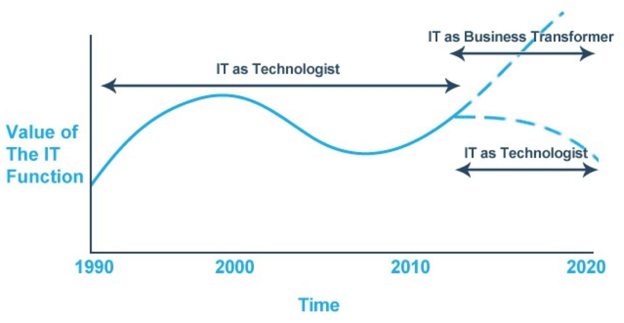
Figure 1: Value of IT Function
Source: Info-Tech Research Group
Many things develop out of silo-based organizations, however, most of them are not positive. The characteristics and traits that do develop from these environments end up working against the organization and cost them in lost revenue, missed business opportunities, lost knowledge, and lost human capital. By not partnering with the business IT fails to understand the business, and by not understanding the business it leads to a decline in organization satisfaction with IT as a whole.
So, what is and where is the organization dissatisfied with IT? Between 2011-2013 satisfaction among executives regarding IT’s ability to meet key business objectives dropped steadily. Most notably, with respect to revenue generating objectives such as product creation and entering new markets.
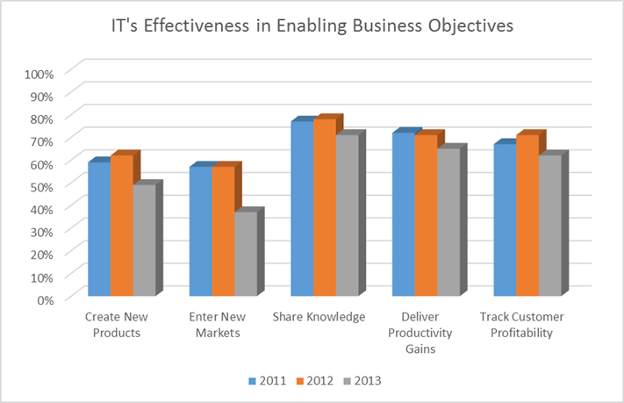
Table 2: IT’s Effectiveness in Enabling Business Objectives
Source: McKinsey & Company. IT Under Pressure: McKinsey Global Survey Results
The role of the CIO today is strategic business partner first and technology specialist second. It’s essential the role demonstrates the ability to drive the organization toward their strategic goals. This means readjusting priorities for managing IT and moving more toward becoming business oriented. So, what does this really translate to?
This means the primary business role of IT is to:
- 1. Act as strategic business partner and adviser to the business
- 2. Drive new business initiatives
- 3. Improve the customer experience
- 4. Develop innovative products and services
What is standing in the way of the CIO transforming into the business partner that is now expected from the role? A shift in focus and thinking is required. First, the CIO needs to think and act like a business leader. Second, the CIO needs to align IT more toward the customer. Third, he or she needs to manage change and talent. This involves developing plans to acquire the necessary talent, and grow their IT team within the organization. How is all this accomplished? The top five success factors for CIOs today are:
- 1. Strong stakeholder management skills
- 2. Visionary and strategic thinking
- 3. Deep understanding of the business
- 4. A seat at the top management table
- 5. Oversight of all relevant resources: people, spend, etc.
If the transformation of the CIO and IT are going to be successful, they must ensure they are incorporating the factors above.
So far we’ve covered why CIOs are not successful, the transformation of the CIO role and IT function, where IT is falling short today regarding the effectiveness in enabling business objectives, and the top five areas where the CIO/IT must focus to ensure a successful business partnership with the organization.
With this critical information now at hand where does the CIO go from here, and how do they know their strategic compass is pointing true North? As a C-level IT executive now working with the business, the most important business stakeholder is the CEO. Confirming the CIO and CEO are both in alignment with the strategic direction is critical to success.
Southeast Technologies works with CIOs in this area to ensure proper IT-business alignment. Let us partner with you by taking part in our CEO-CIO Alignment Program. This assessment will provide you insights on:
- Understanding the CEO’s perception of and vision of IT for your business
- Creating a plan to address alignment gaps impeding business growth
- Identifying and building core IT processes that automate IT business alignment
- Delivering your plan to demonstrate IT value and progress.
The program will zero in on exactly what and where IT priorities need to be and offers a roadmap to the benefits that come with alignment.
For more information on this program and others please contact us today!